Built to Keep You Warm: Why Campbell Homes Uses Blown-In Fiberglass Insulation
When you tour a new home, you judge what you can see—the finishes, the floor plan, the kitchen. But the thing that will quietly shape how comfortable you feel every single day is the one thing you’ll never lay eyes on again after move-in: the insulation behind your walls and above your ceiling.
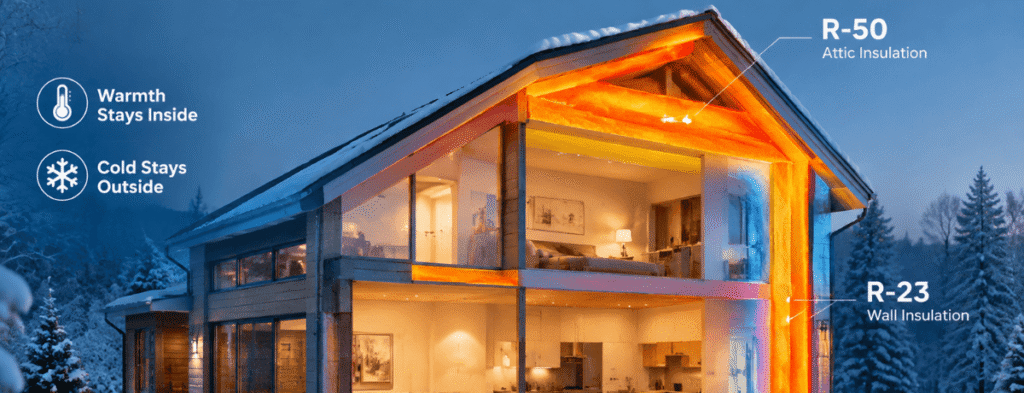
At Campbell Homes, every home is built with blown-in fiberglass insulation—R-50 in the attic, R-38 over unconditioned space and R-23 in the walls. That’s a deliberate choice, not a default. Here’s why it matters for your comfort, your energy bills, and the long-term quality of your home along Colorado’s Front Range.
The short answer: why blown-in fiberglass
Blown-in fiberglass is a loose-fill insulation installed to completely fill the attic and wall cavities, creating a seamless thermal barrier with very few gaps. Campbell Homes chooses it over the common alternatives—cellulose and fiberglass batts—because it holds its insulating power for the life of the home, resists moisture and fire, and keeps rooms more evenly comfortable through Colorado’s cold winters and warm summers.
It’s a small line item most buyers never ask about. It’s also one of the clearest examples of a philosophy Campbell Homes has held since 1965: quality is a creed, and we don’t cut corners.
What R-value actually means for you
R-value measures how well insulation resists heat flow. The higher the number, the better it slows heat from escaping in winter and entering in summer. Colorado Springs sits in a cold climate zone (IECC Climate Zone 5), where energy codes call for substantial insulation – R-49 in the attic, R-19 to R-30 for floors over unconditioned space and R-13 to R-21 in the walls.
Campbell Homes builds to R-50 in the attic, R-38 in floors over unconditioned space, and R-23 in the walls, meeting the energy standards for our region and pushing performance above the typical minimum. In plain terms, that translates to:
- A home that holds its temperature. Less heat escapes in January, less sneaks in during July—so your furnace and AC work less to keep you comfortable.
- Lower, steadier energy bills. A tighter thermal envelope means you’re not paying to heat the outdoors.
- Fewer cold spots and drafts. Even insulation coverage means the back bedroom feels as comfortable as the living room.
This efficiency is built in from the start as part of Campbell Homes’ energy-efficient construction materials and systems—not an upgrade you have to negotiate for later.
Blown-in fiberglass vs. the alternatives
Not all insulation performs the same over the years. Here’s how blown-in fiberglass compares to the two most common options—and why Campbell Homes made the call it did.
Fiberglass vs. cellulose: settling and lost R-value
The R-value printed on an insulation package only matters if the material keeps it. Loose fiberglass experiences less than 2% settling and delivers its stated R-value for the life of the home. Cellulose, by contrast, can settle up to 25% over time—and as it compresses, it can lose up to a quarter of its insulating value. A ceiling that started strong can quietly underperform a decade later.
Moisture: dry vs. wet installation
Fiberglass doesn’t absorb moisture and is installed dry. Cellulose is naturally absorbent and is often applied with water. That matters, because moisture trapped in building cavities can cause real problems: lost R-value, corrosion of metal fasteners, wiring, and piping, and degradation of the wood framing and drywall around it. Choosing a material that stays dry protects the bones of the house, not just its efficiency.
Fire resistance
Fiberglass is naturally non-combustible, classified as such under ASTM E136—no chemical treatment required. Cellulose is made from paper and other wood-based materials, so it has to be treated with fire-retardant chemicals to be acceptable in construction. And Kraft-faced batts aren’t fire-resistant at all, because the paper facing is combustible. For a material sitting inside every wall and ceiling, non-combustible by nature is the safer starting point.
Batts vs. blown: the installation problem
Batt insulation is easy to install, which is exactly why it’s so often installed imperfectly. It’s very difficult to fit batts without leaving gaps—and even a small void, like the space around an electrical outlet, can reduce a wall’s overall R-value by as much as 50%. Blown-in fiberglass flows into those gaps and fills the cavity completely, creating a far more seamless, efficient thermal barrier than batts can provide.
As Manuel Rodrigues, Vice President of Purchasing and Sales at Campbell Homes, puts it: “Choosing the right building products is one reason that Campbell Homes is known for quality. We don’t skimp or cut corners—we do the right thing for our buyers.”
Why this matters more in Colorado
Insulation isn’t an abstract spec sheet here—it’s the difference between a home that fights the climate and one that works with it. Colorado Springs winters are genuinely cold, with sharp temperature swings between sunny afternoons and freezing nights. A home that holds its heat keeps you comfortable without running the furnace around the clock, and a dry, non-settling insulation stands up to decades of that seasonal cycling far better than materials that compress or absorb moisture.
That long-term performance is also why build quality should weigh into which builder and which community you choose. Campbell Homes’ commitment to doing the hidden work right shows up across its master-planned neighborhoods throughout the Colorado Springs area and is backed by the kind of service and warranty support that reflects confidence in how these homes are built.

The takeaway
Insulation is invisible, but you’ll feel it every day you live in the house—in how comfortable each room stays, in what your energy bills look like, and in how well the home holds up over the years. Campbell Homes builds with blown-in fiberglass insulation (R-50 attic, R-23 walls) because it performs for the life of the home, resists moisture and fire, and keeps your home evenly comfortable through every Colorado season.
It’s the kind of decision you’ll never see once the drywall goes up—which is exactly why it’s worth knowing your builder got it right.
Combined with Campbell Homes’ full OSB wrap, your home’s exterior envelope will be built significantly better than a standard code-minimum production home.
Want to see how Campbell Homes builds quality into every layer of your home? Explore available floor plans and energy-efficient new builds, or reach out to the team to talk through building your next home in Colorado Springs.
Frequently asked questions
What insulation does Campbell Homes use?
Campbell Homes builds every home with blown-in fiberglass insulation—R-50 in the attic, R-38 in the floors over unconditioned space, and R-23 in the walls. It’s installed to fill cavities completely, creating a seamless thermal barrier that keeps homes comfortable and energy-efficient.
Is blown-in fiberglass better than cellulose or batt insulation?
For long-term performance, yes. Blown-in fiberglass settles less than 2% (so it holds its R-value for the life of the home), doesn’t absorb moisture, and is naturally non-combustible. Cellulose can settle up to 25% and is applied with water, while batts are prone to installation gaps that can cut a wall’s R-value by up to 50%.
What does R-value mean, and is R-50 good for an attic?
R-value measures how well insulation resists heat flow—higher is better. R-50 in the attic meets the energy standards for Colorado Springs’ cold climate zone (IECC Zone 5), helping keep heat in during winter and out during summer.
How does good insulation lower my energy bills?
A higher-performing, gap-free thermal envelope means your home loses less heat in winter and gains less in summer. Your furnace and air conditioner run less often to maintain a comfortable temperature, which lowers and steadies your energy costs.
Why does insulation quality matter in Colorado Springs?
Colorado’s cold winters and big daily temperature swings put real demand on a home’s thermal envelope. Insulation that resists settling and moisture keeps rooms evenly comfortable and performs reliably for decades of seasonal cycling.
Key points
- Campbell Homes builds with blown-in fiberglass insulation—R-50 attic, R-23 walls—in every home. It’s a deliberate quality choice, not a default.
- It holds its performance. Blown-in fiberglass settles less than 2% and keeps its rated R-value for the life of the home; cellulose can settle up to 25% and lose insulating value.
- It resists moisture and fire. Fiberglass is installed dry and is naturally non-combustible (ASTM E136), unlike water-applied cellulose or combustible Kraft-faced batts.
- It fills the gaps batts miss. Even a small void around an outlet can cut a wall’s R-value by up to 50%; blown-in fiberglass creates a far more seamless barrier.
- It meets Colorado’s cold-climate energy standards. R-50 attic and R-23 walls suit Colorado Springs’ Climate Zone 5, supporting lower, steadier energy bills and fewer drafts.
- It reflects how Campbell Homes builds. As VP Manuel Rodrigues says, “We don’t skimp or cut corners—we do the right thing for our buyers.”
Summary
Insulation is one of the most important parts of a home you’ll never see again after move-in, and it quietly determines everyday comfort, energy costs, and long-term durability. Campbell Homes builds every home with blown-in fiberglass insulation (R-50 attic, R-23 walls)—chosen over cellulose and batts because it settles less and holds its R-value for the life of the home, stays dry and resists moisture damage, is naturally non-combustible, and fills the gaps that undermine batt insulation. In Colorado Springs’ cold Climate Zone 5, that adds up to a home that holds its temperature, keeps energy bills lower and steadier, and performs reliably for decades. For buyers, it’s proof of a building philosophy Campbell Homes has followed since 1965: getting the hidden work right, because quality is a creed and corners don’t get cut.